Racial Profiling by Alison Marie Behnke
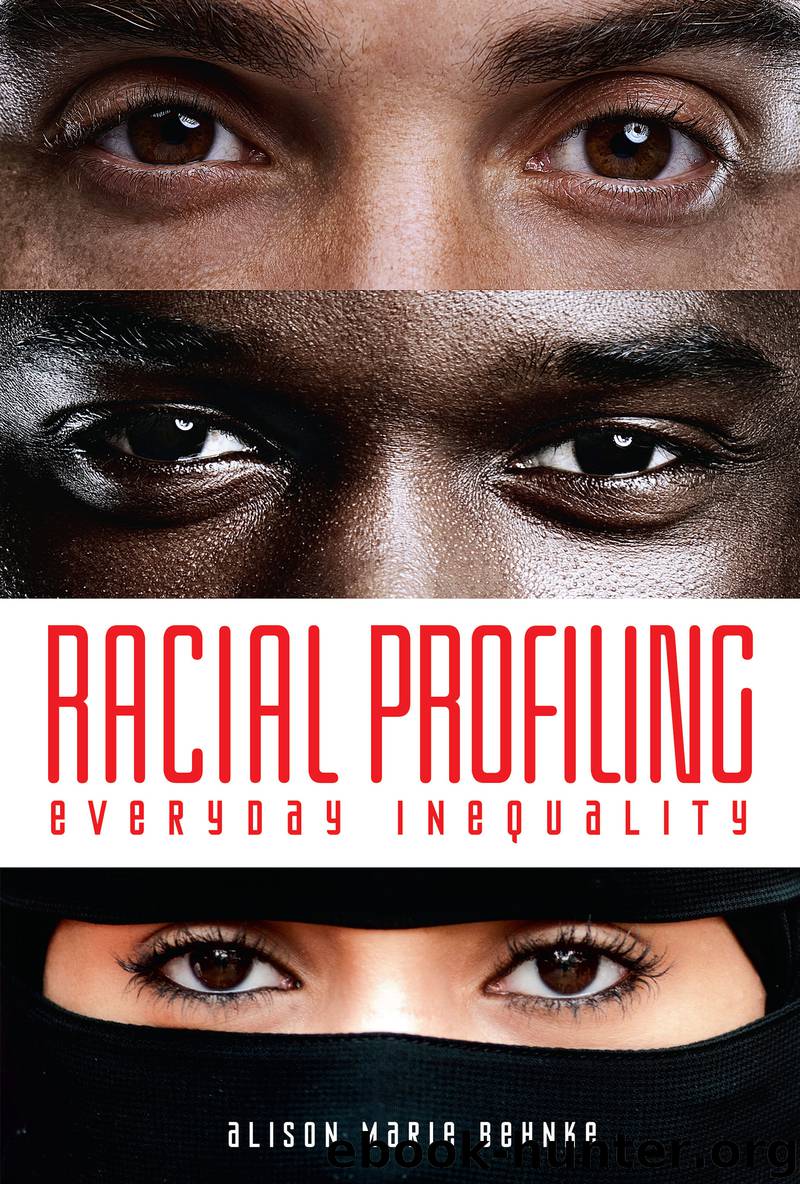
Author:Alison Marie Behnke [Behnke, Alison Marie ]
Language: eng
Format: epub
Tags: African American, African Americans, American Indians, Arab Americans, Asian Americans, Black American, Black Americans, Black History, Counterterrorism, Crime, Discrimination, General, History, Immigration, Immigration Laws, Institutional Racism, Islamophobia, Latino, Latinos, Law, Law & Crime, Law Enforcement, Multiculturalism, Muslim Americans, Nonfiction, Police, Police Brutality, Prejudice, Racial Profiling, Racism, Social Studies, Stereotypes, Systemic Racism, Young Adult Nonfiction, Young Adults
ISBN: 9781512439212
Publisher: Lerner Publishing Group
Published: 2016-12-31T16:00:00+00:00
According to the Centers for Disease Control and Prevention, African Americans and American Indians are most at risk for fatal encounters with law enforcement. Their rates of death at the hands of police officers far surpass the national average of 1.2 people for every 1 million people in the United States.
Activists affiliated with the Black Lives Matter movement rally around the stories of Michael Brown (left), Eric Garner (center), Tamir Rice (right), and other unarmed black people killed by police.
In most of these cases, officers deny that racial profiling played a role in their decisions. However, witness testimony and video footage of incidents often indicate that racially biased targeting took place. Even so, the majority of officers implicated in using excessive force against people of color face no criminal charges. While police departments have fired officers involved in high-profile cases, disciplinary action for less publicized incidents is often much lighter.
The degree to which racial profiling plays a role in cases of police brutality is impossible to measure precisely. Taken together, however, fatal encounters between police officers and people of color illustrate the high costs of race-based suspicions and assumptions. Writer Bijan Stephen speaks of the toll these tragedies take on minority communities: “I, along with every other black person in America, live with fear every day.”
Case Study: Michael Brown
On the afternoon of August 9, 2014, Michael Brown and a friend, Dorian Johnson, were walking down the street in Ferguson, Missouri, a suburb of Saint Louis. Brown and Johnson, both black, were eighteen and twenty-two years old, respectively. They had just left Ferguson Market and Liquor, where security video later showed that an African American male had shoplifted cigarillos and shoved the store’s clerk on his way out. Darren Wilson, a white officer with the Saint Louis Police Department, drove by on patrol, noticed the young men, and approached them. Based on the young men’s appearance and the fact that Brown held cigarillos, Wilson may have identified Brown and Johnson as suspects in the convenience store theft.
What happened over the next few minutes is unclear, but the interaction ended with Wilson shooting Brown at least six times in the head, chest, and arm. A few minutes later, an ambulance happened to pass by the scene and a paramedic declared Brown dead. His body then lay in the street for more than four hours. A crowd, largely neighborhood residents, soon gathered. Saint Louis officials later said this disorder may have delayed authorities in collecting Brown’s body. Whatever the reason for the delay, the stark sight of a dead black teenager lying in the summer sun left a deep impression. As one local put it, “You’ll never make anyone black believe that a white kid would have laid in the street for four hours.”
Conflicting stories about how Brown was killed soon flooded the news. Brown’s friend Dorian Johnson said Brown had raised his hands and said, “Don’t shoot” before Wilson fired. Other witnesses disagreed. Some observers dwelled on the possibility that Brown may
Download
This site does not store any files on its server. We only index and link to content provided by other sites. Please contact the content providers to delete copyright contents if any and email us, we'll remove relevant links or contents immediately.
Evelina by Fanny Burney(26990)
Call Me by Your Name by André Aciman(20710)
The Secret History by Donna Tartt(19460)
Primed Son (Dark Siren Book 4) by Eden Ashley(19002)
Shot Through the Heart by Niki Burnham(17490)
Who'd Have Thought by G Benson(16718)
All the Missing Girls by Megan Miranda(16681)
Eleanor and Park by Rainbow Rowell(15658)
Ready Player One by Cline Ernest(15139)
Always and Forever, Lara Jean by Jenny Han(15066)
A Web of Lies 27 by Bella Forrest(13897)
Fallen Heir by Erin Watt(13517)
The Cruel Prince (The Folk of the Air Book 1) by Holly Black(12683)
Bull's Eye Sniper Chronicles Collection (The Second Cycle of the Betrayed Series) by McCray Carolyn(12532)
Crooked Kingdom: Book 2 (Six of Crows) by Bardugo Leigh(12445)
Shadow Children #03 - Among the Betrayed by Margaret Peterson Haddix(12023)
Twisted Palace by Erin Watt(11268)
Warriors (9781101621189) by Young Tom(10981)
Simon vs. the Homo Sapiens Agenda by Becky Albertalli(10635)
